The 8-Dimension Call-Coaching Rubric (and How to Score a Sales Call)
Most teams “coach” calls on gut feel. A manager listens to a recording, says “that was a good one” or “watch your tone,” and moves on. It does not scale, it is not fair, and it never adds up to a trend you can act on.
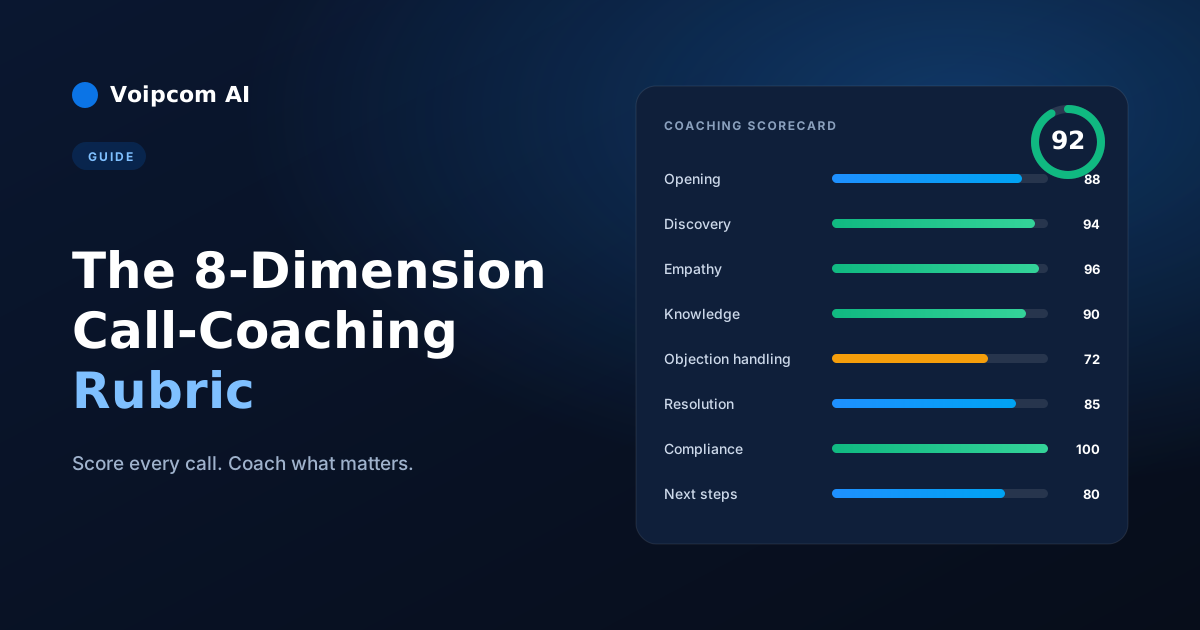
A rubric fixes that. When every call is graded the same way, coaching stops being an opinion and starts being evidence. Here is the eight-dimension rubric we use to score every sales and support call, what each dimension measures, and how to turn the scores into coaching that actually changes behavior.
Why a rubric beats gut feel
- Consistency. A new rep and a tenured rep are measured on the same scale, so a 78 means the same thing in March as it does in September.
- Fairness. Reps see the exact lines that earned each score, so feedback is about the call, not the personality.
- Trends. Scores roll up. You can see who is sliding on objection handling before it shows up in the pipeline.
- Coaching, not just grading. A number on its own changes nothing. A number plus the quoted moment that produced it is a coaching session.
The eight dimensions
1. Opening
Did the rep set the agenda, confirm time, and earn the right to ask questions? A strong opening frames the call so the rest of it has somewhere to go. Weak openings drift.
2. Discovery
Did the rep uncover the real problem, the impact, and the timeline, instead of pitching features at a stranger? Good discovery is mostly listening, with questions that go one layer deeper than the obvious answer.
3. Empathy
Did the rep reflect the customer’s concern back accurately before solving it? Empathy is not warmth for its own sake. It is the rep proving they understood, which is what makes the customer willing to keep talking.
4. Knowledge
Were the answers accurate, specific, and confident? This is where credibility is won or lost. Hedging, wrong details, or “let me get back to you” on basics all cost points.
5. Objection handling
When the customer pushed back on price, timing, or risk, did the rep acknowledge it, isolate it, and address it with evidence, rather than steamrolling or folding? The best reps treat objections as discovery, not combat.
6. Resolution
Did the call actually move the issue forward, or did it just end? For support that means the problem is solved or has a clear path. For sales it means a real next commitment, not a vague “I’ll think about it.”
7. Compliance
Did the rep say what they are required to say and avoid what they are not? Disclosures, consent, and accurate claims matter, and in regulated work like healthcare and law firms a single missed line is the whole risk.
8. Next steps
Did the call end with a specific, scheduled, mutually agreed action? “I’ll follow up next week” is not a next step. “I’m sending the proposal today and we’re reviewing it Tuesday at 10” is.
How to score a call without it taking all day
Score each dimension on a simple scale (0 to 100, or 1 to 5, pick one and stick to it). For every score, grab the exact quote from the transcript that justifies it.
Then weight the dimensions so the overall number reflects what your business actually cares about. A composite we like:
Quality 40% + Sentiment 25% + First-Call Resolution 20% + Rubric 15%
Tune the weights to your team. A support org might push First-Call Resolution higher; a new-logo sales team might weight Discovery and Next Steps.
Turn scores into coaching
The scores are the input, not the output. The output is one focused thing each rep works on next.
- Pick the single lowest dimension that shows up across an agent’s recent calls, not a laundry list.
- Bring the quoted moments, good and bad, to the one-to-one. Hearing themselves is worth more than hearing you.
- Recheck it next week. Coaching that is not measured is just advice.
Or let it run itself
Scoring every call by hand against eight dimensions is the right idea and the wrong amount of work. Nobody listens to 1,200 calls a month.
That is exactly what Voipcom AI does automatically. It listens to every call your team takes, scores it on this same eight-dimension rubric with evidence quotes pulled straight from the transcript, ranks the team on a weighted leaderboard, and writes your managers a briefing every Monday on who to coach and why. It is available exclusively to Voipcom voice clients.
See it run on a real call, end to end, in fifteen minutes. Book a free demo.
See your calls scored on this rubric, automatically.
Voipcom AI scores and coaches every call your team takes. Book a free 15-minute demo and watch it run on a real call.
Book a Free Demo